
Google Reviews Are Critical for Small Businesses (And Other Truths Nobody Needed Me to Tell You)
Alright, let’s address the elephant in the room: writing an article titled “Why Google Reviews Are Critical for Small Businesses” in 2025 is like writing “Why You Should Probably Breathe Oxygen” or “Fire: Still Hot After All These Years.” We all know this. Your grandmother knows this. That guy selling essential oils from his van definitely knows this.
But here’s the thing – knowing something and actually understanding WHY it works are two very different things. Most small business owners treat Google reviews like they’re collecting baseball cards: “Oh cool, I got another one!” without grasping the mechanics of what’s actually happening. So let me break down the real reasons Google reviews matter, minus the generic marketing fluff you’ve read seventeen times already.
Social Proof Isn’t Magic – It’s Your Customers Doing Your Job For You
Every marketing guru on the planet loves throwing around “social proof” like it’s some mystical force. “Harness the power of social proof!” they shriek from their webinar thrones. Yeah, okay, calm down. Social proof is just a fancy term for “people believe other people more than they believe you.”
Shocking revelation, right? When you tell potential customers you’re amazing, they think you’re full of it. When twelve strangers say you’re amazing, suddenly it’s gospel truth. This isn’t marketing wizardry – it’s basic human psychology that’s been operating since the first caveman recommended a good rock to another caveman.
Here’s what actually matters: those stars next to your business name are doing the heavy lifting you used to have to do yourself. Before the internet, you had to convince every single customer that you weren’t going to screw them over. Now? Those reviews are your 24/7 sales team working for free, telling your story when you’re asleep, on vacation, or doing literally anything else.
And that “68% more likely to trust” statistic everyone quotes? That’s actually conservative. In reality, people trust online reviews almost as much as personal recommendations. Almost. So if you’re wondering whether you need Google reviews, you’re asking the wrong question. The right question is: “Do I want customers, or do I want to go out of business while pondering the importance of customer acquisition?”
Google Reviews Are SEO Rocket Fuel (But Not How You Think)
This is where most articles go completely off the rails with vague promises about “boosting your ranking” like it’s some magical incantation. Let me give you the actual mechanics without the mystical BS.
Google’s algorithm is essentially a massive trust calculator. It’s constantly asking: “Is this business legitimate? Do real humans interact with it? Should I show this to people searching, or is this another fly-by-night operation that’ll be gone in six months?” Your reviews answer all these questions simultaneously.
More reviews = more signals that you’re a real business with real customers. Fresh reviews = signals that you’re currently operational, not some abandoned digital storefront. Review responses = signals that there’s an actual human running this thing. Google aggregates all this data and decides whether you deserve to appear when someone searches for what you do.
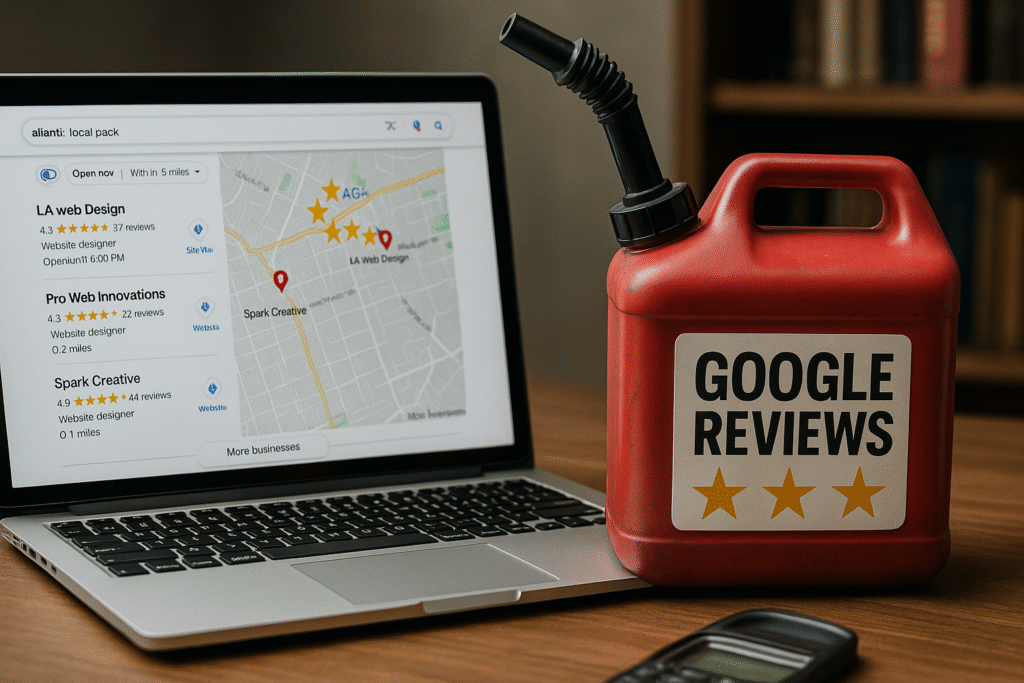
And that Local Pack placement? The three businesses that show up in the map section at the top of search results? That’s not random. That’s Google’s algorithm saying “These are the businesses I trust most to not make me look stupid for recommending them.” Getting into that Pack means you’re basically standing at the front of the line while your competitors are in the parking lot wondering where all the customers went.
But here’s what nobody tells you: you’re competing against businesses with bigger budgets, better websites, and marketing teams. Yet Google doesn’t care. If you’ve got consistent reviews and they don’t, you win. It’s the great equalizer, and most small businesses are too busy “not having time for marketing” to actually use it.
Your Reviews Are a Free Focus Group (That You’re Probably Ignoring)
Want to know what marketing consultants charge thousands of dollars to tell you? Read your freaking reviews. All of them. Not just the 5-star ones that make you feel fuzzy inside.
Every review is a customer literally telling you what they think about your business. This is data companies pay fortunes to collect through surveys, focus groups, and elaborate research projects. You’re getting it for FREE, and most business owners skim it like it’s their terms and conditions agreement.
When someone leaves a positive review mentioning your “fast service,” that’s not just a compliment – that’s telling you what to emphasize in your marketing. When someone mentions your “friendly staff,” you now know that’s a differentiator. When someone complains about parking, you’ve just identified a friction point that’s costing you customers.
And here’s the part that should terrify you into action: not responding to reviews is like having customers shout feedback at you while you stare at the wall and hum loudly. It makes you look either incompetent or dead. Neither is great for business.
When you respond – especially to negative reviews – you’re not just talking to that one customer. You’re performing for every future customer reading through your reviews trying to decide if you’re legit. Handle criticism well, and you’ve just converted a negative into a demonstration of your professionalism. Ignore it, and everyone assumes the complaint is valid and you don’t care.
Your Competitors Are Probably Terrible at This (Congrats, You Win By Default)
Here’s the beautiful truth about small business competition: most of your competitors are astonishingly bad at basic business practices. They don’t ask for reviews. They don’t respond to reviews. They treat their Google Business Profile like a digital afterthought they set up once in 2017 and never touched again.
This means your bar for victory is pathetically low. You don’t need to be perfect. You don’t need a sophisticated review generation system. You literally just need to be consistently not-terrible at asking satisfied customers to leave reviews and then responding to them when they do.
When a potential customer is comparing you to your competition, those stars aren’t decorative. They’re decision-makers. Two businesses offering the same service at similar prices, but one has 47 reviews averaging 4.8 stars and the other has 3 reviews from 2019? That’s not even a competition. That’s a massacre.
The Uncomfortable Part Where I Tell You to Actually Do Something
Look, Google reviews aren’t some optional nice-to-have feature you’ll “get around to eventually.” They’re the difference between showing up in searches and being invisible. Between customers trusting you and choosing literally anyone else. Between growing your business and wondering why nobody’s calling.
The simply fact is, the businesses that ask for reviews get them. The businesses that don’t, don’t. It’s not more complicated than that. There’s no secret sauce. No magic timing. No perfect strategy. Just ask your happy customers to tell Google they’re happy. Make it easy. Do it consistently.
And for God’s sake, respond to the reviews. All of them. It takes three minutes and signals to both Google and potential customers that you’re actually running a business instead of just hoping for the best.
Google reviews aren’t the future of small business marketing – they’re the present, and they have been for years. You’re either using them or you’re getting steamrolled by the businesses that are. Your choice.
About the Author Tim Dini
For specific help marketing your business, contact me by clicking here.