
Google’s Finally Admitting What’s Really Killing Your Traffic (Spoiler: It’s Not What Your SEO Guru Told You)
Or: How I Learned to Stop Worrying and Love the Algorithm
So Liz Reid, Google’s Head of Search and someone who’s been there long enough to remember when “organic traffic” wasn’t a fantasy bedtime story, just dropped some truth bombs that are making SEO consultants everywhere sweat through their “I Speak Algorithm” t-shirts.
And here’s the kicker: Everything you’ve been hearing about AI Overviews murdering your website traffic? Yeah, that’s not actually what’s happening. The real story is so much worse and also kind of hilarious if you enjoy watching an entire industry collectively miss the point.
The AI Overview Panic That Wasn’t
Remember when everyone started screaming that AI Overviews would be the apocalypse for ad revenue? That Google was basically committing financial suicide by summarizing everything right there on the search page? Turns out that was about as accurate as your uncle’s Facebook predictions about cryptocurrency.
Reid confirmed what anyone paying attention already knew: ad revenue is “relatively stable.” Not tanking. Not circling the drain. Just… fine. And here’s why… most searches never had ads anyway because who’s buying banner space for “what temperature do I bake salmon” or “is a hot dog a sandwich”? (It’s not. Fight me.)
But here’s where it gets interesting. AI Overviews are actually making people search MORE. Like giving a toddler a button that makes funny noises, once you realize how easy it is, you can’t stop pressing it. Google proved this already with Google Lens, where making search ridiculously easy created an entirely new category of queries. People weren’t visual-searching before because it was a pain in the tail feathers, not because they didn’t want to.
The Inconvenient Truth Your SEO Dashboard Won’t Tell You
Now we get to the part where I’m going to ruin some people’s consulting gigs.
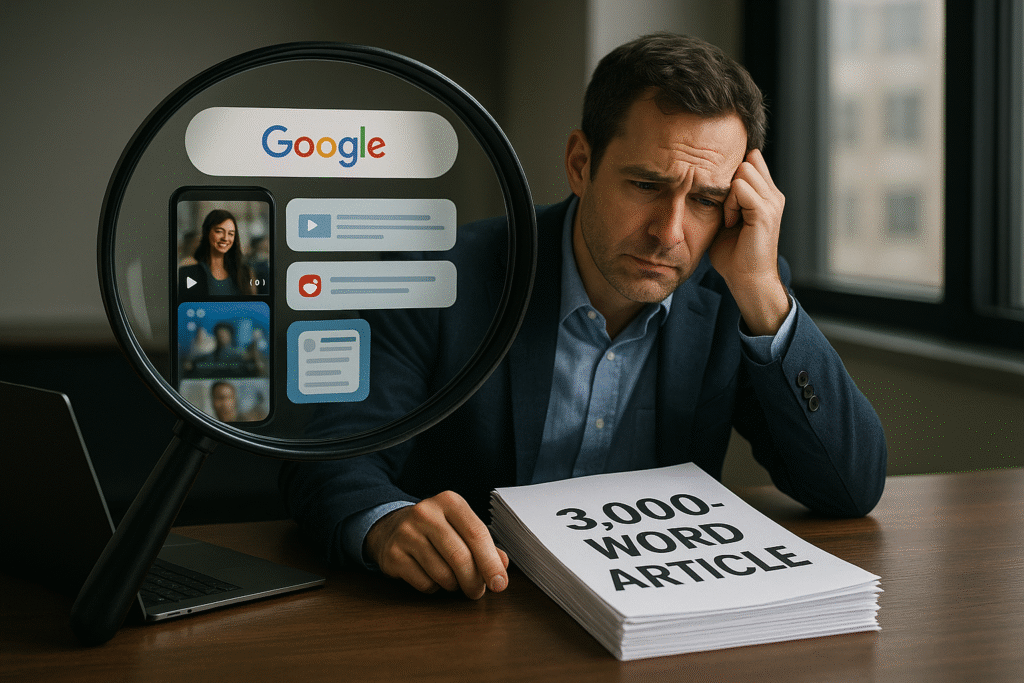
Your traffic isn’t dropping because of AI. It’s dropping because nobody wants to read your 3,000-word blog post about “10 Tips for Better Time Management” when they could watch a 47-second TikTok that explains it better while someone dances to a Dua Lipa song.
Reid laid it out plainly: there’s been a massive behavioral shift, especially with younger users who would rather chew glass than read your carefully SEO-optimized article about literally anything. They want short-form video instead of your essays. They want Reddit threads instead of your “authoritative” blog posts. They want podcasts instead of your white papers that nobody asked for. They want YouTube tutorials instead of your recipe blog that makes them scroll through your entire life story before revealing that yes, you do need to add salt to the water.
Google’s algorithm updates? Those aren’t causing the shift, they’re RESPONDING to it. Google’s just surfacing what people actually want, which apparently isn’t your content. Sorry. I don’t make the rules. Actually, your audience does, and they voted with their clicks.
How Google Actually Works (Hint: They’re Just Watching You)
Here’s Google’s dirty little secret that isn’t actually a secret: they just watch what users do and then give them more of that. Reid literally said, “We have to respond to who users want to hear from.” It’s not some mysterious algorithm conspiracy. If users prefer a Reddit thread over your blog post, Google’s going to rank the Reddit thread higher. This is like being mad at Netflix for recommending action movies after you’ve watched nothing but action movies for six months.
Google does extensive user research, testing, and behavior tracking, then adjusts accordingly. They’re not sitting in a dark room cackling while they destroy small businesses. They’re trying to give people what they’re already demonstrating they want. If that’s not your content, well, Houston, you have a problem.
The Content That Survives the Bloodbath
So what actually works? What kind of content still gets clicks even when there’s an AI Overview sitting right there like a party crasher who already told the punchline?
Content that’s richer and deeper than what an AI can spit out. Not surface-level garbage that ChatGPT could’ve written during its lunch break. Content with actual human perspective and expertise… you know, the stuff where you can tell a real person who actually knows their stuff and has battle scars to prove it wrote it. Material from creators who spent real time and brought actual craft to their work, not someone who spent 20 minutes spinning an AI article through a thesaurus and called it “original.”
Here’s something else Google’s tracking that should terrify content farms: “bounced clicks.” That’s when someone clicks your result and immediately runs back to the search page like they just opened a door to find their parents making out. AI Overviews are actually helping filter out the crud that doesn’t provide anything beyond what the AI already summarized. If your entire article can be accurately summarized in three sentences by an AI, you don’t have an article, you have an elaborate waste of everyone’s time.
The Inline Link Revolution (Or: How to Win Without the Click)
Here’s the new game nobody’s talking about enough: Google’s adding more inline links directly in AI Overviews. This is actually brilliant if you think about it. Getting cited with an inline link means your brand gets visibility even without the click. You’re positioned as the authority. You’re building brand recognition that drives direct visits later when people remember “oh yeah, that site actually knows what they’re talking about.”
To capitalize on this, you need to stop being “another website covering the same topic” and start being “THE definitive source on this specific thing.” Which means you need to actually BE the expert, not just play one on the internet.
The Dead Internet Theory and Why Google Gives a Damn
When asked about the “dead internet theory”, the delightful idea that the web will become nothing but AI-generated slop talking to other AI-generated slop while humans watch in horror from the sidelines, Reid basically said “yeah, we’re worried about that too.”
Google’s response? They’re prioritizing content with human perspective and actual expertise. They’re filtering out what Reid beautifully called “AI slop” (finally, someone at Google with a sense of humor). They’re upweighting content from creators who bring unique insights and real craft.
Translation: if your content strategy is “have AI write everything and pray,” you’re building a house on quicksand. Google confirmed they want to surface content showing real human expertise, not recycled AI summaries that read like they were written by a very confident but ultimately clueless intern.
The Silver Lining for the Weird Kids
Plot twist: AI search might actually help niche creators. Because AI allows for super-specific, long-tail queries. Someone can now search for “a red, short dress for a wedding, made by a merchant who uses sustainable practices and doesn’t exploit workers.” That level of specificity helps Google connect users with niche creators who would never rank for generic terms like “red dress.”
So if you’re the weird specialist in your field (the person who knows everything about one very specific thing) AI search might be your best friend. Generic content creators? You’re in trouble. But if you’re the go-to expert on something specific? You just got a megaphone.
Your Actual Action Plan, Not the Horse(Squeeze) One
Based on Reid’s insights, here’s what you actually need to do, minus the corporate happy talk:
First, create content deeper and more valuable than an AI can summarize. If ChatGPT can write your article, you don’t have expertise… you have access to the same training data everyone else does. Go beyond surface-level information. Share your actual testing results. Talk about your failures. Explain your specific processes that you learned through years of trial and error.
Second, add genuine human perspective and expertise. This means being a real person who’s actually done the thing you’re writing about, not someone who researched it for 20 minutes on Google. Your audience can smell fake expertise like a dog smells fear.
Third, adapt to how users actually consume information. If your audience prefers video, make video. If they want quick answers, provide them. Stop insisting that your preferred format is the only legitimate one. That’s like being the person still arguing that vinyl is objectively superior while everyone else uses Spotify.
Fourth, build brand recognition and trust. In an AI-driven world, being a recognizable and trusted brand matters more than ever. People need to know who you are and why they should care about what you’re saying.
Fifth, focus on specific, niche topics where you can be the definitive authority. Generic content is going to get buried so deep archaeologists won’t find it. But if you’re the absolute expert on one specific thing? You’ve got a moat.
The Bottom Line (Because You Skipped Here Anyway)
The publishers and creators who thrive aren’t going to be the ones whining about AI summaries on LinkedIn. They’re going to be the ones creating content so valuable that users want to click through even AFTER reading the AI summary. They’re going to be the ones who understand that the game changed, adapted, and moved forward instead of writing think pieces about the good old days of organic traffic.
Google’s not killing your traffic. Your audience’s preferences are. And Google’s just following them to the party. You can either show up too, or you can stand outside complaining that parties used to be better. Your choice.
Now stop reading articles about SEO and go create something actually worth finding.
About the Author Tim Dini
For specific help marketing your business, contact me by clicking here.